

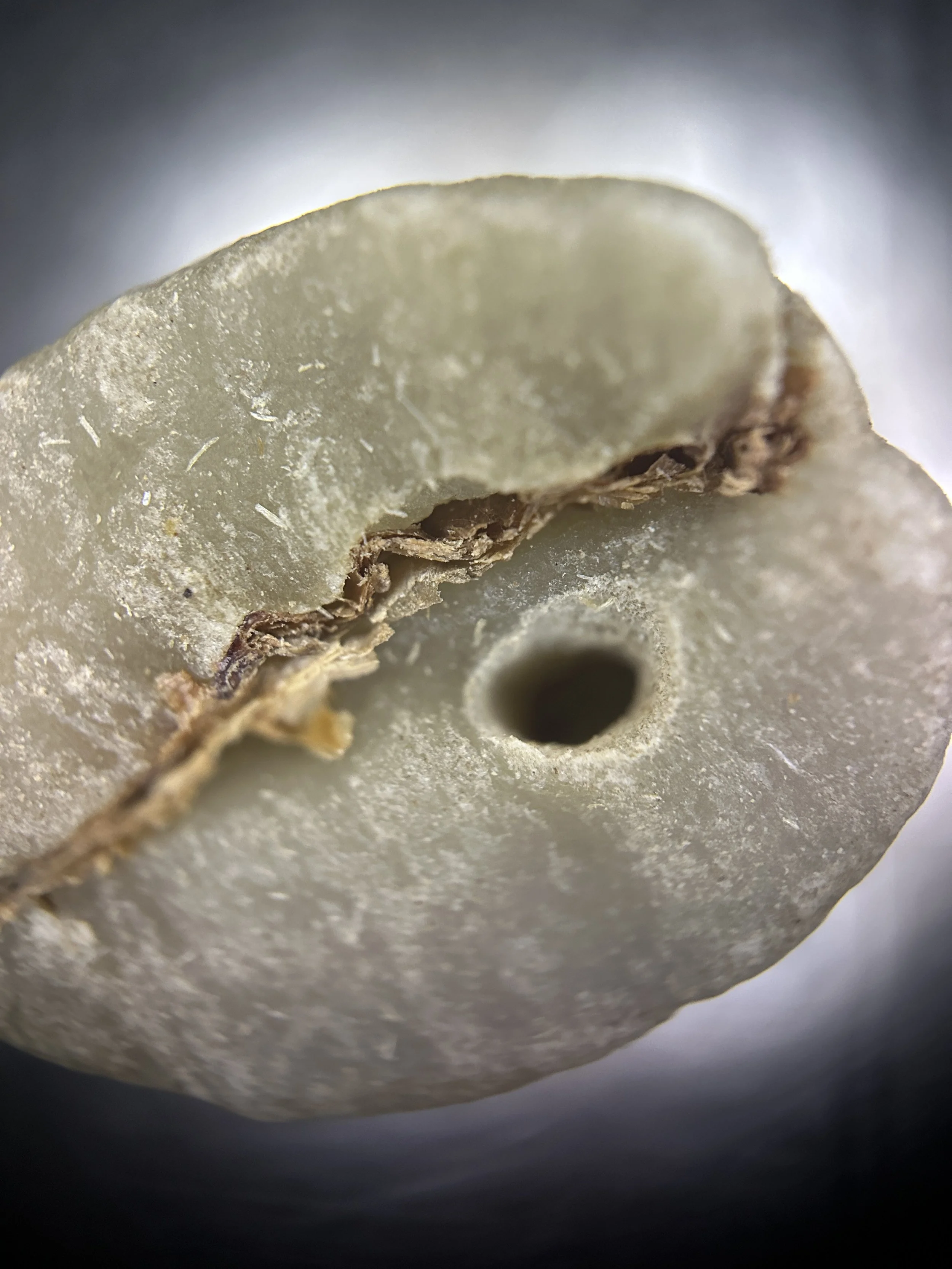
A close up picture of a green coffee bean with a hole created by an insect.
Definition of Insect Damage
According to the SCA/CQI standards, an insect-damaged bean is defined as slight when there are two or fewer holes present on the coffee bean. It is defined as severe when three or more holes are present on the coffee bean.
Five “severe” insect-damaged coffee beans in a 350-gram sample constitute a Primary Defect, and 10 “slight” insect-damaged coffee beans represent one Secondary Defect.
Classifying Insect-Damaged Coffee
The second set of defects I would like to investigate more deeply is insect-damaged coffee. This one is significantly more straightforward to diagnose than immature coffee beans, and you can lose a lot less sleep over whether you were being too harsh on the coffee or not in how you sorted and graded the coffees. If there is a hole in the coffee that resembles insect damage, it is likely insect damage. Then, count the holes and categorize them accordingly.
If the insect damage happens to fall on a bean that is immature, sour, or black. You will generally sort it into the category that demonstrates the most potential for flavor impact. For example, insect damage on a partially sour coffee bean should be categorized as partial sour since a partial sour is more likely to cause a flavor impact compared to a slight insect damage.
Insect Damage Impact on Flavor
This is where things start to become a little less clear. While we have good clarity on how to identify them and how to categorize them, the big question is, “So what?” What is the overall impact that insect-damaged coffee will have on the flavor and quality of the roasted coffee? Before diving into my experience, I’ll cite some fantastic resources that are out there about green coffee that directly address this topic:
SCAA Arabica Green Coffee Defect Handbook:
“Varies. Impacts the appearance of the roasted beans, can result in dirty, sour, Rioy, or moldy flavors, especially if present in high quality.”
Coffee: Growing, Processing, Sustainable Production Ed. Jean Nicolas Wintgens
Slight Insect-Damage
“Cup profile: Minor presence of off-flavors. Slightly diminished aroma, flavor, and acidity.
“Negative effect on cup quality: Low to Medium.”
Severe Insect-Damage
“Cup profile: Significant incidence of off-flavors with a predominantly bitter and tarry flavor. Total loss of aroma, flavor, and acidity.”
“Negative effect on cup quality: High to very high.”
Dear Coffee Buyer - by Ryan Brown:
“Tastes like: no perceptible flavor in best cases, but consequential contamination can result in earthy, dirty, sour, or over-fermented flavors.”
It’s critical to point out here that many of these sources are recognizing that there may not be any taste faults associated with slight insect damage at all. In fact, from what I can tell there is a concern with damage to the appearance of the coffee (customers may not go after coffee with holes in it?), and some legitimate concern to the coffee roasting differently (not cited above, but included in the works). Coffee Growing, Processing, and Sustainable Agriculture cites insect damage as resulting in coffees that are overly roasted compared to their counterparts in the roasting machine. When it comes to slight insect damage, this could be something worth exploring ourselves to see if this is true, or not regarding deeper roast color, unevenness in roasting, etc.
Something Ryan Brown mentions, that i think is a fabulous way of putting it is that “consequential contamination” is the real problem. While the insect damage can change the shape of the bean, and how it responds to heat energy transfer… the real worry are the potential things that happen after the insect has contacted the coffee seed. When something cuts into the coffee seed when it is still at a higher moisture content (and I’ll just assume that these insects haven’t bathed lately) then there is a huge potential to introduce micro-organisms to the coffee where they can breed and grow. We see this frequently in severly insect damaged coffee seeds like the one pictured below:
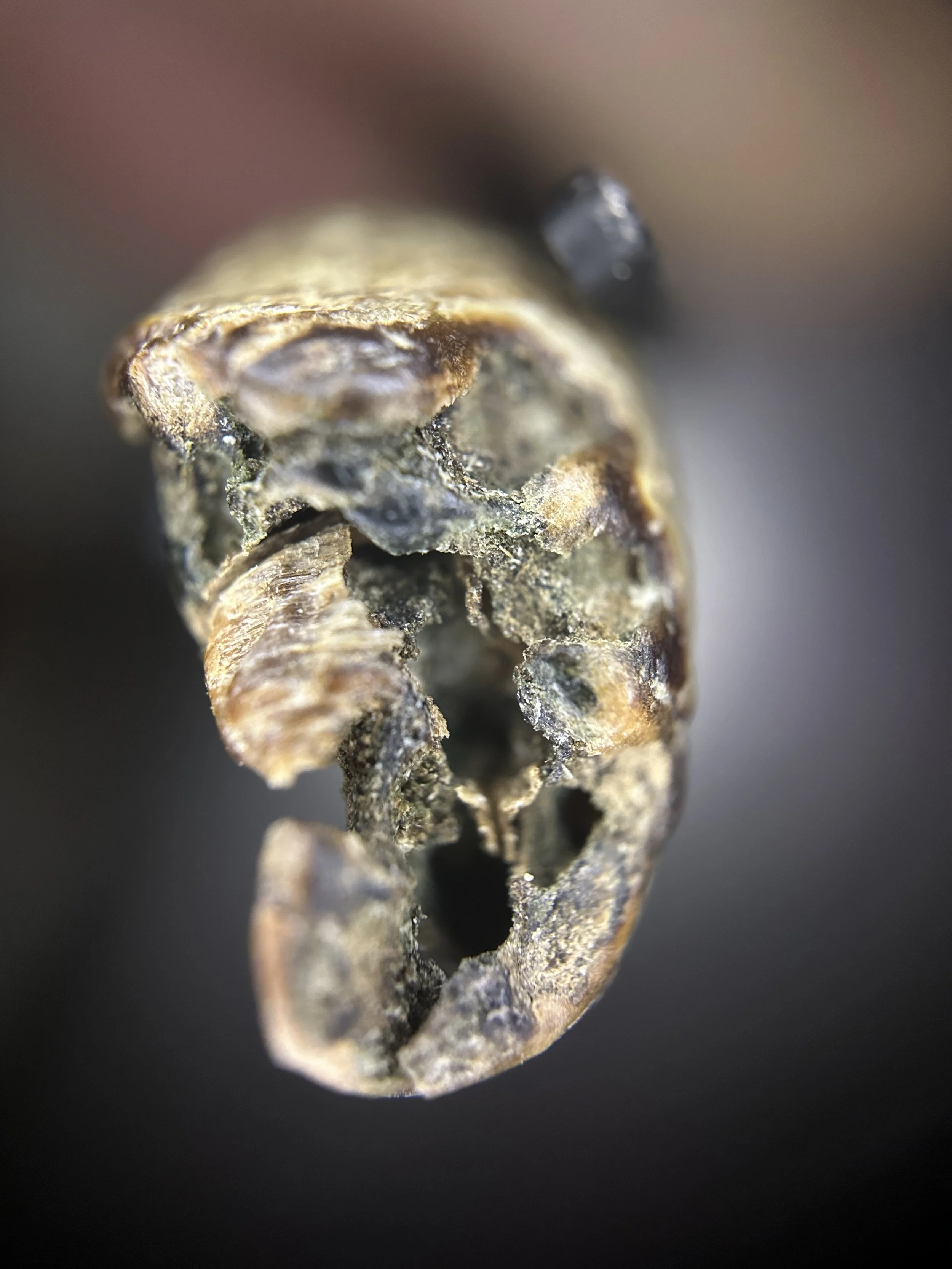
Above, you can see discoloration on the coffee seed due to the activity of microbes, bacteria, yeast, etc. The damage caused by these microbes, including OTAs, is what Ryan Brown likely refers to when he says “consequential contamination.” There is potential for more significant issues regarding the flavor of the coffee.
As a result, it may be beneficial for us as green coffee buyers, who are trying to be fair and equitable while also understanding the quality risks inherent in a coffee lot, to break down the insect-damaged beans further. Perhaps we should categorize them as slight, severe, and discolored. In doing so, we can properly rate the impact on the flavor of the coffee and avoid needlessly penalizing a coffee for defects that will still taste perfectly fine.